
 Ph.D. Student, School of Computer Science, Shanghai Jiao Tong University
Hi! I am Xuan Gong (Xander Gong), a second-year Ph.D. student in the School of Computer Science at Shanghai Jiao Tong University.
My research focuses on optimization and reinforcement learning for foundation models (LLMs, VLMs, etc.), exploring which training signals and experiences are most informative and how to use them for more effective learning. I am motivated by the challenge of moving beyond static datasets toward learning through interaction with complex, partially observable real-world environments. Furthermore, I am interested in connecting algorithmic and theoretical advances with real-world applications, especially in AI for science and embodied intelligence.
If you are interested in partnering on research projects, offering internship opportunities or exchange programs, I would be thrilled to connect with you.
Education
-
Shanghai Jiao Tong UniversitySchool of Computer Science
Ph.D. StudentSep. 2025 - present -
 Tongji UniversityB.S. in Computer Science (GPA rank top 5%)Sep. 2021 - Jul. 2025
Honors & Awards
-
National Scholarship of China2022
-
Outstanding Graduate of Tongji University2025
-
First Prize of The 14th National University Student Mathematics Competition Non-Mathematics Category (Shanghai Region)2022
News
Selected Publications on Google Scholar (view all )
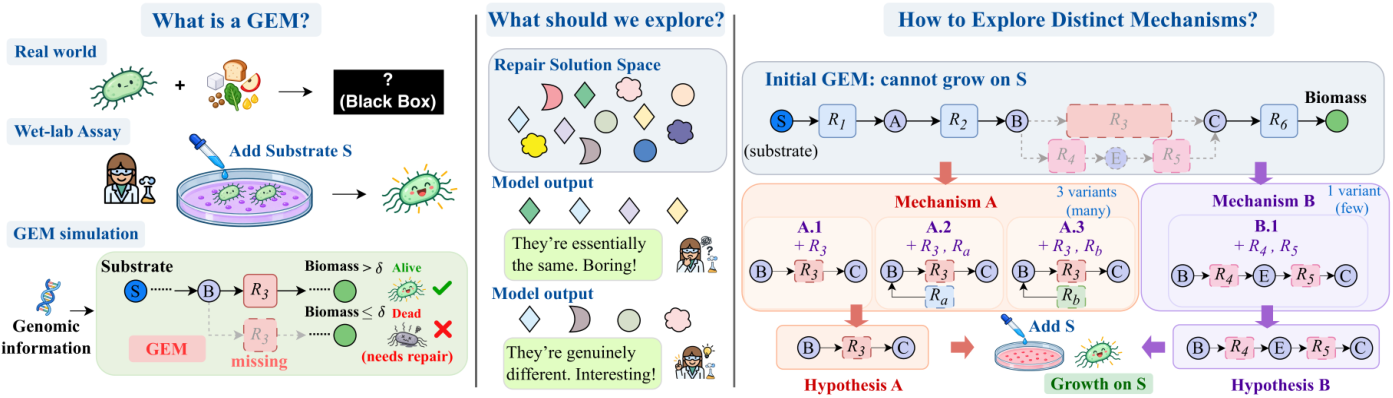
Beyond Action Entropy: Quotient-Space Exploration for Genome-Scale Metabolic Model Repair
Xuan Gong*, Hanbo Huang*, Wenbin Dai*, Jing Wang, Lei Bai, Xiang Xiao, Weishu Zhao, Shiyu Liang# (* equal contribution, # corresponding author)
AgenticLS Workshop @ NeurIPS 2026 Oral
QuotientPO explores distinct biological mechanisms rather than equivalent surface edits, enabling more effective phenotype-supervised repair of genome-scale metabolic models.
Beyond Action Entropy: Quotient-Space Exploration for Genome-Scale Metabolic Model Repair
Xuan Gong*, Hanbo Huang*, Wenbin Dai*, Jing Wang, Lei Bai, Xiang Xiao, Weishu Zhao, Shiyu Liang# (* equal contribution, # corresponding author)
AgenticLS Workshop @ NeurIPS 2026 Oral
QuotientPO explores distinct biological mechanisms rather than equivalent surface edits, enabling more effective phenotype-supervised repair of genome-scale metabolic models.
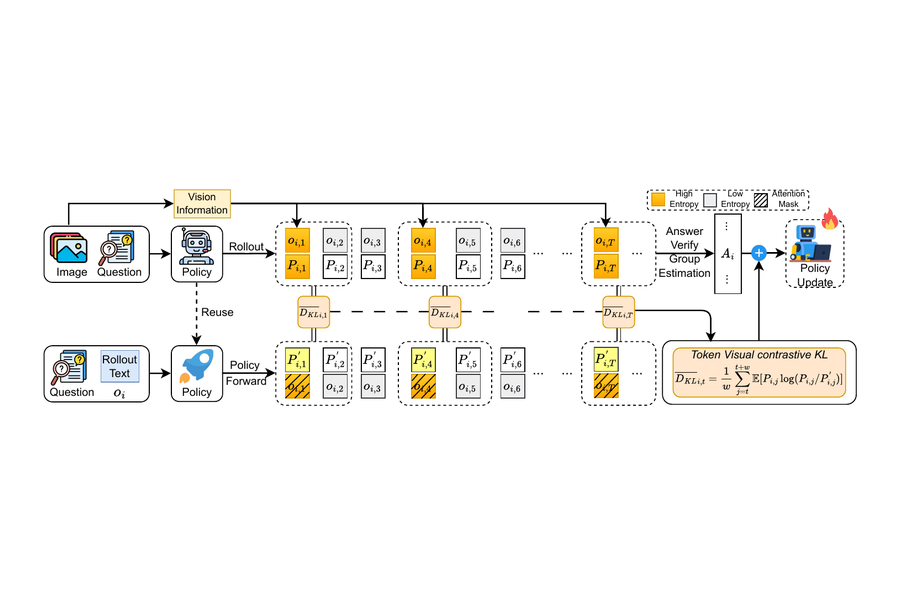
Reflection Anchors for Propagation-Aware Visual Retention in Long-Chain Multimodal Reasoning
Xuan Gong, Hanbo Huang, Hao Zheng, Yiran Zhang, Wenbin Dai, Weishu Zhao, Shiyu Liang# (# corresponding author)
NeurIPS 2026 · CompLearn Workshop @ ICML 2026
This work introduces reflection anchors for propagation-aware visual retention, targeting long-chain multimodal reasoning where visual evidence must remain reliable across extended inference.
Reflection Anchors for Propagation-Aware Visual Retention in Long-Chain Multimodal Reasoning
Xuan Gong, Hanbo Huang, Hao Zheng, Yiran Zhang, Wenbin Dai, Weishu Zhao, Shiyu Liang# (# corresponding author)
NeurIPS 2026 · CompLearn Workshop @ ICML 2026
This work introduces reflection anchors for propagation-aware visual retention, targeting long-chain multimodal reasoning where visual evidence must remain reliable across extended inference.
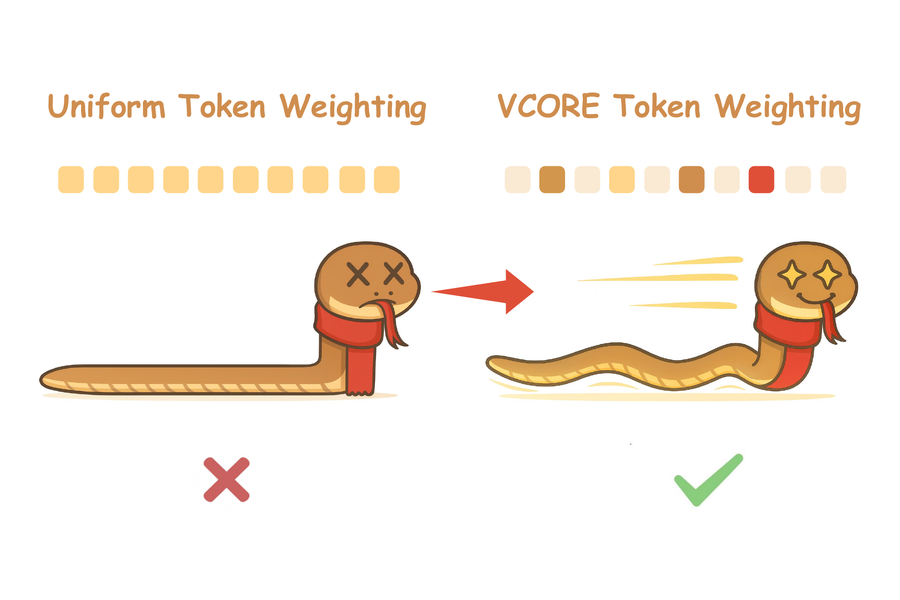
VCORE: Variance-Controlled Optimization-based Reweighting for Chain-of-Thought Supervision
Xuan Gong, Senmiao Wang, Hanbo Huang, Ruoyu Sun, Shiyu Liang# (# corresponding author)
ACL 2026 Main
VCORE introduces variance-controlled optimization-based reweighting for chain-of-thought supervision, improving how reasoning traces contribute to model training.
VCORE: Variance-Controlled Optimization-based Reweighting for Chain-of-Thought Supervision
Xuan Gong, Senmiao Wang, Hanbo Huang, Ruoyu Sun, Shiyu Liang# (# corresponding author)
ACL 2026 Main
VCORE introduces variance-controlled optimization-based reweighting for chain-of-thought supervision, improving how reasoning traces contribute to model training.
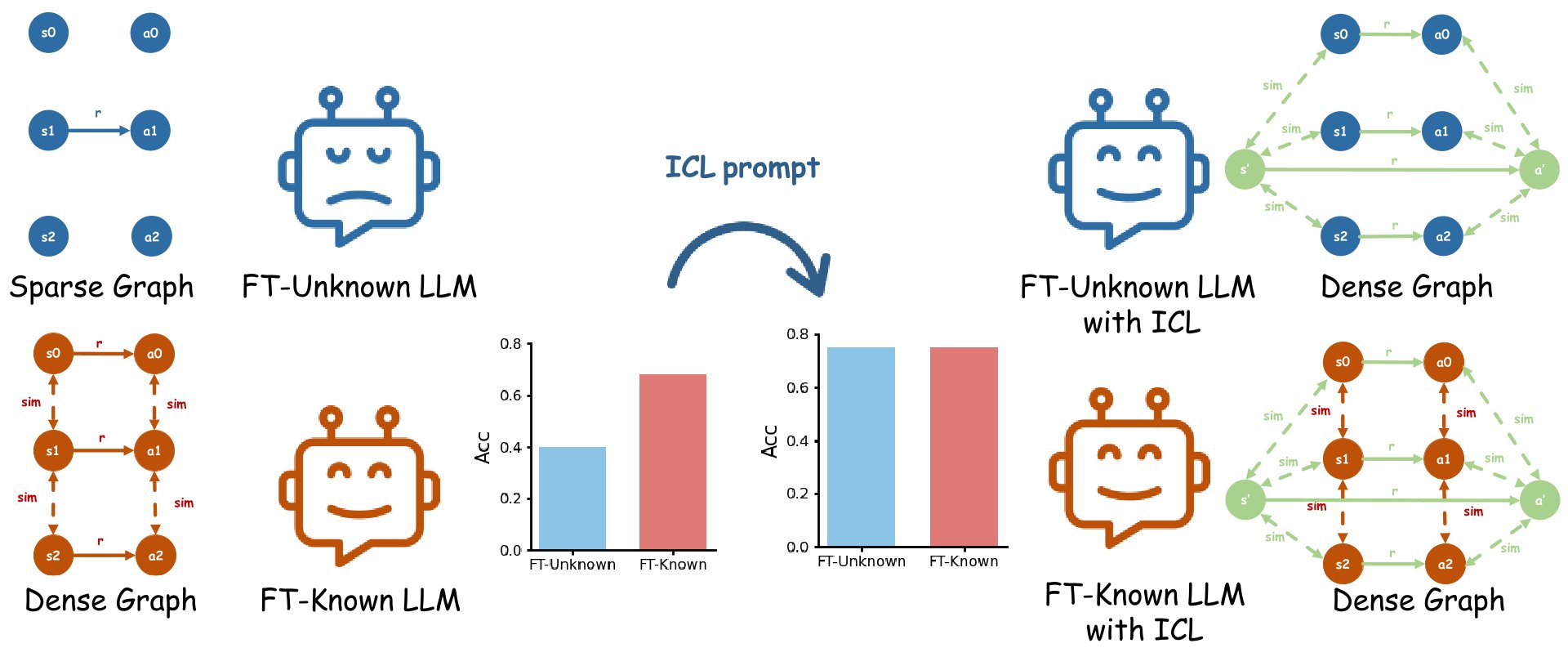
From Parameters to Prompts: Understanding and Mitigating the Factuality Gap between Fine-Tuned LLMs
Xuan Gong*, Hanbo Huang*, Yiran Zhang*, Shiyu Liang# (* equal contribution, # corresponding author)
ICASSP 2026
We revisit how supervised fine-tuning affects factual knowledge in LLMs, revealing a factuality gap between known and unknown knowledge. This gap can be mitigated at inference via in-context learning (ICL) or out-of-distribution prompts. Our theoretical and empirical results show that test-time prompts can overshadow fine-tuning data, suggesting ICL can compensate for poor fine-tuning and should be considered in evaluating fine-tuning strategies.
From Parameters to Prompts: Understanding and Mitigating the Factuality Gap between Fine-Tuned LLMs
Xuan Gong*, Hanbo Huang*, Yiran Zhang*, Shiyu Liang# (* equal contribution, # corresponding author)
ICASSP 2026
We revisit how supervised fine-tuning affects factual knowledge in LLMs, revealing a factuality gap between known and unknown knowledge. This gap can be mitigated at inference via in-context learning (ICL) or out-of-distribution prompts. Our theoretical and empirical results show that test-time prompts can overshadow fine-tuning data, suggesting ICL can compensate for poor fine-tuning and should be considered in evaluating fine-tuning strategies.
DAMRO: Dive into the Attention Mechanism of LVLM to Reduce Object Hallucination
Xuan Gong, Tianshi Ming, Xinpeng Wang, Zhihua Wei# (# corresponding author)
EMNLP 2024 Main
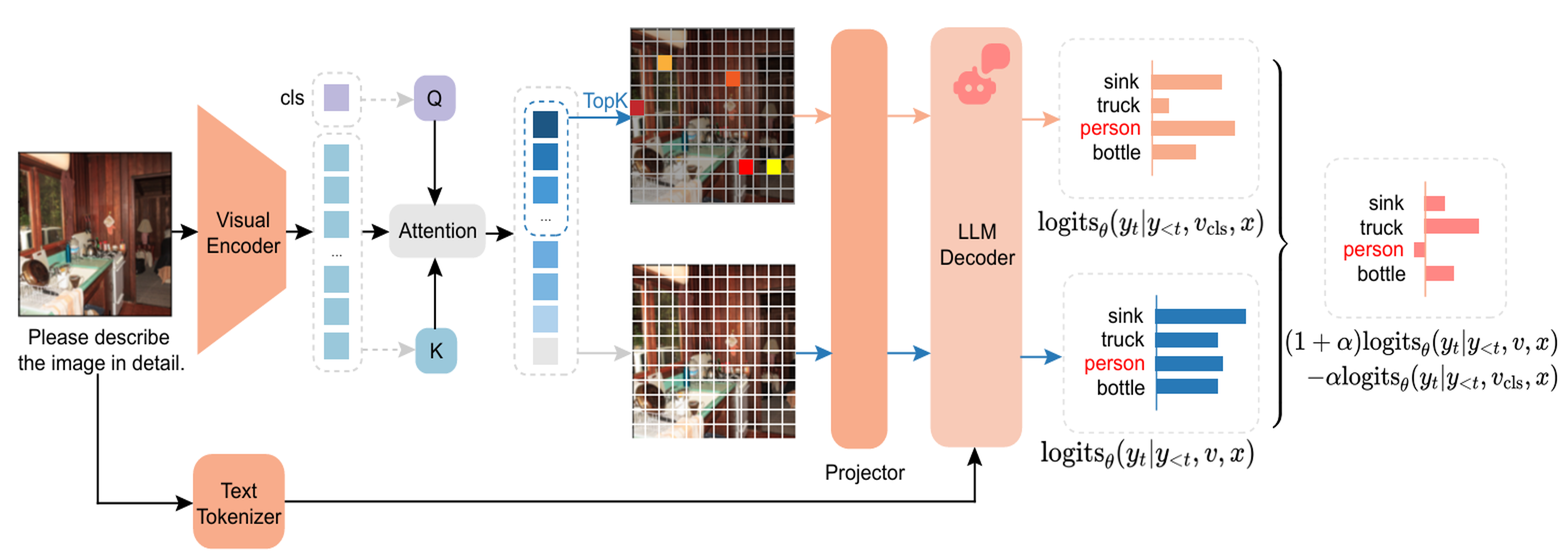
We propose DAMRO, a training-free method to reduce object hallucination in LVLMs by filtering misleading high-attention background tokens using the ViT CLS token. DAMRO significantly improves hallucination control on models like LLaVA and InstructBLIP across multiple benchmarks.
DAMRO: Dive into the Attention Mechanism of LVLM to Reduce Object Hallucination
Xuan Gong, Tianshi Ming, Xinpeng Wang, Zhihua Wei# (# corresponding author)
EMNLP 2024 Main
We propose DAMRO, a training-free method to reduce object hallucination in LVLMs by filtering misleading high-attention background tokens using the ViT CLS token. DAMRO significantly improves hallucination control on models like LLaVA and InstructBLIP across multiple benchmarks.
REACT: Physically and Chemically Consistent Reconstruction of Marine Active Tracers
Wenbin Dai*, Hao Zheng*, Shiyu Liang*#, Chaofan Sun, Xueying Zhang, Hanbo Huang, Xuan Gong, Yiran Zhang, Enhui Liao (* equal contribution, # corresponding author)
NeurIPS 2026 · AI4Physics Workshop @ ICML 2026
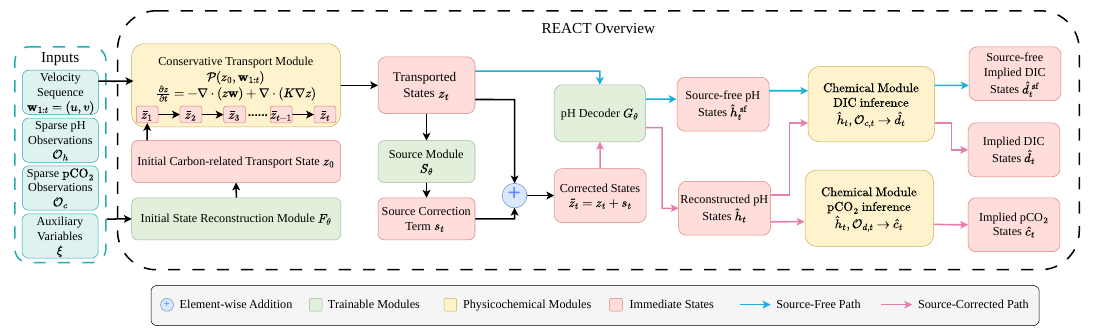
REACT reconstructs sea surface pH from sparse observations through a carbon-first framework that combines conservative transport, active source correction, and chemical decoding to preserve physical and carbonate-system consistency.
REACT: Physically and Chemically Consistent Reconstruction of Marine Active Tracers
Wenbin Dai*, Hao Zheng*, Shiyu Liang*#, Chaofan Sun, Xueying Zhang, Hanbo Huang, Xuan Gong, Yiran Zhang, Enhui Liao (* equal contribution, # corresponding author)
NeurIPS 2026 · AI4Physics Workshop @ ICML 2026
REACT reconstructs sea surface pH from sparse observations through a carbon-first framework that combines conservative transport, active source correction, and chemical decoding to preserve physical and carbonate-system consistency.
RLCracker: Evaluating the Worst-Case Vulnerability of LLM Watermarks with Adaptive RL Attacks
Hanbo Huang, Yiran Zhang, Hao Zheng, Xuan Gong, Yihan Li, Lin Liu, Zhuotao Liu, Shiyu Liang# (# corresponding author)
ICML 2026
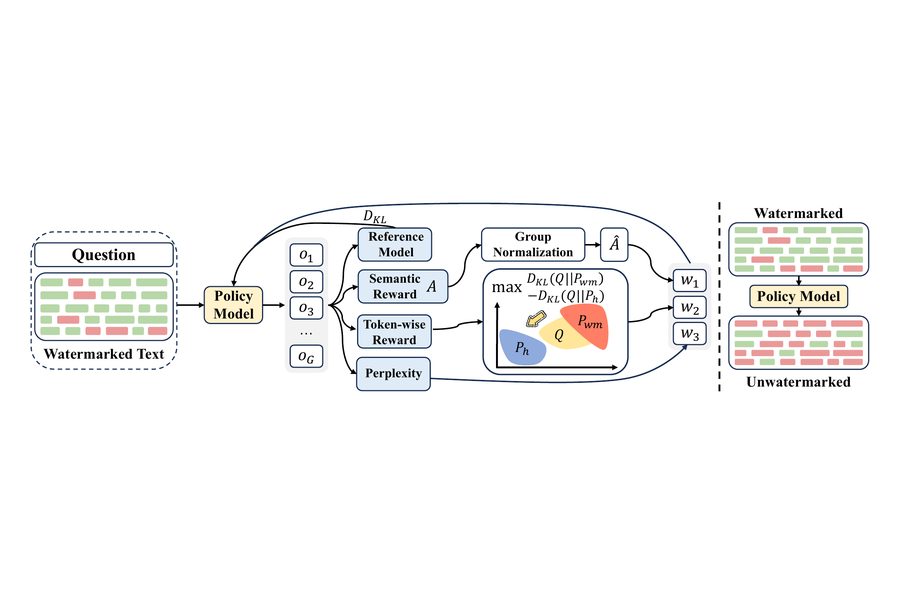
RLCracker studies adaptive reinforcement-learning attacks against LLM watermarks, exposing watermark vulnerabilities under learned black-box attack policies.
RLCracker: Evaluating the Worst-Case Vulnerability of LLM Watermarks with Adaptive RL Attacks
Hanbo Huang, Yiran Zhang, Hao Zheng, Xuan Gong, Yihan Li, Lin Liu, Zhuotao Liu, Shiyu Liang# (# corresponding author)
ICML 2026
RLCracker studies adaptive reinforcement-learning attacks against LLM watermarks, exposing watermark vulnerabilities under learned black-box attack policies.
RLSpoofer: A Sample-Efficient Black-Box Spoofing Attack for Stress-Testing LLM Watermarks
Hanbo Huang, Xuan Gong, Yiran Zhang, Hao Zheng, Wenbin Dai, Jieren Kuang, Shiyu Liang# (# corresponding author)
Trustworthy AI for Good (AI4GOOD) Workshop @ ICML 2026
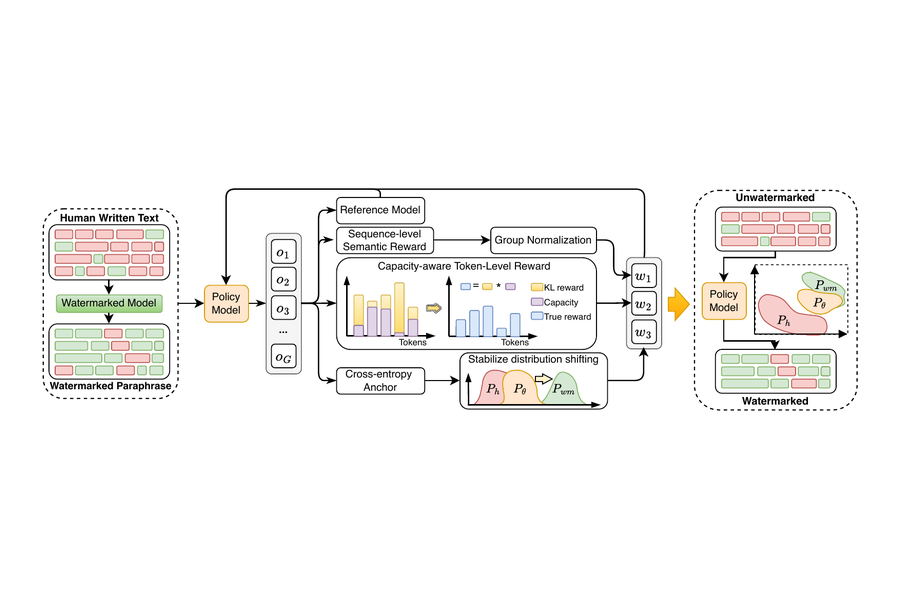
This workshop paper studies sample-efficient black-box spoofing attacks for stress-testing the robustness of LLM watermarks.
RLSpoofer: A Sample-Efficient Black-Box Spoofing Attack for Stress-Testing LLM Watermarks
Hanbo Huang, Xuan Gong, Yiran Zhang, Hao Zheng, Wenbin Dai, Jieren Kuang, Shiyu Liang# (# corresponding author)
Trustworthy AI for Good (AI4GOOD) Workshop @ ICML 2026
This workshop paper studies sample-efficient black-box spoofing attacks for stress-testing the robustness of LLM watermarks.